Coinbase CX Design
Redesigning Coinbase’s automated support experience from a generic chatbot into a context-aware resolution engine.
TL;DR
- Context
- As part of the NYU Blockchain & Fintech Product Team’s collaboration with the CX team at Coinbase, we studied where automated support fails in high-stakes situations including failed transactions, restrictions on accounts, verification problems, security breaches, and escalation.
- My Role
- I translated our team’s research findings into a succinct product strategy and interaction model for a context-aware support system. I defined core features, mapped out the required customer and transaction context, scoped the MVP, and prototyped key resolution and escalation flows.
- Outcome
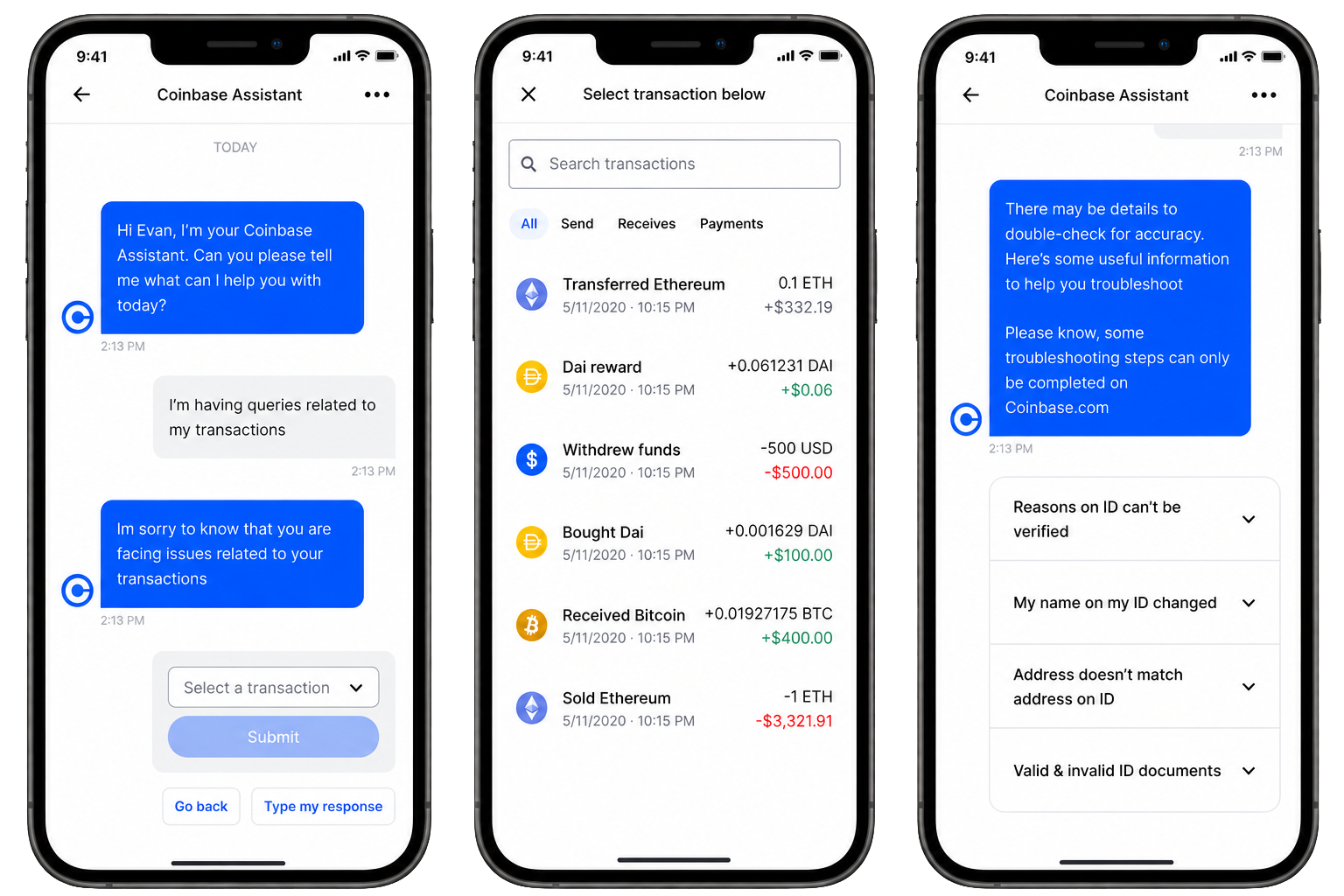
- We redesigned the chatbot around five capabilities to directly address the failures we found: layered responses, account-aware guidance, visible case progress, deep links that surfaced the correct workflows, and escalation that fully preserved the user’s context.
- Learning
- Users lose trust in a support product when it necessitates that they carry the state of their own problem (tracking what happened, figuring out the next steps, repeating context, etc.). Strong AI support systems earn their trust by carrying that burden for them.
- Thanks
- Disha Kannan, Aarav Gupta, and the NYU Blockchain & Fintech Product Team.
The bot provided information, but left users to manage the resolution
Coinbase support often begins in high-stress situations when a user cannot access their funds, complete verification, or secure their account. In these moments, they’re seeking to understand what’s happening and what their next steps should be; abstract and generic responses don’t cut it.
We initially focused on improving response quality through simple fixes including shorter copy, clearer formatting, and a more reassuring tone. However, interviews with users demonstrated that they were more frustrated about continuity (or rather, the lack thereof). The bot didn’t reliably surface user context, visually indicate their progress towards a resolution, quickly connect them to relevant workflows, or preserve what they had already explained when escalating. Trust broke across handoffs — between chat, app navigation, workflow status, and human agents — not inside one message.
Core challenge: Redesign the Coinbase CX experience around reaching resolutions rather than emptily serving answers.
Constraints: Make complex guidance navigable under stress, avoid unsafe or inaccurate recommendations, and create patterns that scale across support categories.
Success metrics: Automated resolution rate, guided-action completion, repeat contact rate.
When I have a high-stakes account or transaction issue, help me quickly grasp what’s happening and what to do so that I can feel in control of the situation.
The solution shifted work from the user to the system
The winning support experience does not choose between AI and humans. It designs the handoff between them. We moved the question from “How should the bot respond?” to “What does the system need to know, show, and do?” - and designed five capabilities around that:
- Clarity-first responses. Responses lead with what is happening, the most important next step, and a direct action. Supporting detail remains available without competing for attention.
- Context-driven guidance. The system draws from account status, verification state, recent transactions, prior support activity, security signals, and user expertise to determine what is relevant - not merely to make the response sound personalized.
- Visible progress. A progress tracker shows the completed steps, active blockers, expected timing, and when to expect another update.
- Actionable recommendations. Buttons and deep links instantly navigate to the exact transaction, verification flow, dispute process, or support case, removing the need to translate instructions into navigation.
- Hassle-free escalation. The agent receives a structured record of the issue including relevant account and transaction context, attempted steps, blockers, the reason for escalation, and recommended next steps.
The bot should feel like an elevator that leads to the resolution, rather than a map leading to a staircase.
We avoided designing “AI magic” and instead scoped the MVP around the minimum useful layer of context: layered responses, agent handoff summaries, deep links, and a progress tracker — not a full personalization engine.
The real work was mainly in designing a system for the ideal CX, not the interface layer
This project broadened my thinking around AI product design. Support spans account data, in-app workflows, case progress, and human escalation. A designer’s role is less about scripting responses than about defining how responsibility moves through a system.
My biggest takeaway is that trustworthy AI is measured less by how convincingly it responds than by how reliably it steers the user towards a resolution.